Chinese Robots Revolutionize UK Retail Operations
Discover how Chinese robotics firms are transforming the UK retail sector amid labour shortages and weak productivity growth. Industry transformation ahead.
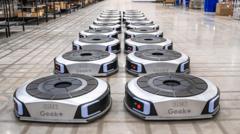
Chinese Robotics Reshaping UK Retail Landscape
The emergence of Chinese robots in UK retail represents a significant shift in how Britain's commercial sector addresses persistent operational challenges. Chinese robots are becoming increasingly prevalent across retail environments, driven by the nation's ongoing struggle with labour scarcity and sluggish productivity expansion. This technological influx marks a watershed moment for the industry, forcing established retailers to reconsider their operational strategies and workforce management approaches.
Understanding the Current UK Retail Challenge
Britain's retail sector faces unprecedented headwinds. Weak productivity growth has plagued the industry for years, creating a competitive disadvantage against international counterparts. Simultaneously, labour shortages have intensified operational pressures, making it increasingly difficult for retailers to maintain service quality while managing costs effectively. These converging factors have created an environment where alternative solutions—particularly automation technologies—appear increasingly attractive to business decision-makers.
The productivity gap remains one of retail's most pressing concerns. Unlike manufacturing sectors that have successfully implemented automation, retail operations have traditionally relied on human workforce deployment. This reliance has left UK retailers vulnerable to demographic shifts and changing employment patterns. When combined with wage pressures and recruitment difficulties, the case for technological intervention becomes compelling.
Why Chinese Robotics Firms Are Seizing the Opportunity
Chinese robotics manufacturers have recognised the strategic opening presented by UK market conditions. These companies bring several competitive advantages: lower production costs, rapid innovation cycles, and substantial experience deploying robotic solutions across Asia's retail environments. Chinese robots offer retailers tangible solutions for warehouse automation, inventory management, and customer service applications.
The financial calculus favours automation investment. With labour costs rising and worker availability declining, retailers discover that robotic systems provide favourable long-term return on investment. Chinese manufacturers have engineered their offerings to address specific retail challenges: high-speed sorting, precise inventory tracking, and repetitive task execution with minimal human intervention.
Applications Transforming Retail Operations
Chinese robots are finding diverse applications throughout UK retail operations. Warehouse facilities employ autonomous robots for order fulfilment, dramatically increasing throughput while reducing operational errors. Automated guided vehicles transport goods across distribution centres with minimal human oversight. These Chinese robots enhance safety by removing workers from hazardous environments while simultaneously accelerating delivery capabilities.
Customer-facing applications are equally significant. Some retailers have introduced robotic systems for shelf scanning and inventory verification, ensuring product availability and pricing accuracy. Backend operations utilise robotic process automation for administrative tasks, freeing human employees to focus on customer engagement and complex problem-solving activities.
The Broader Impact on UK Retail Industry
This technological transformation carries substantial implications for Britain's retail landscape. As Chinese robots become more prevalent, competitive pressures will likely accelerate adoption across the sector. Early adopters gain operational advantages, while laggards face rising cost pressures. The integration of these technologies may paradoxically support employment by enabling retail expansion and allowing workers to transition toward higher-value service roles.
However, the transition presents challenges. Workforce displacement concerns require careful management through retraining programmes and employment transition support. Industry leaders acknowledge that successful automation integration depends on balancing technological advancement with social responsibility and employee wellbeing.
Strategic Considerations for UK Retailers
Retailers evaluating automation investments must consider multiple factors beyond immediate cost savings. System reliability, integration with existing infrastructure, and vendor support quality all influence implementation success. Chinese robotics firms increasingly offer comprehensive service packages, providing installation, training, and ongoing maintenance support to UK retailers.
The competitive landscape is evolving rapidly. As Chinese robots prove their effectiveness across UK retail operations, further investment and refinement appear inevitable. Retailers who delay automation decisions risk losing operational efficiency advantages to competitors who embrace these technologies earlier.
Conclusion
The presence of Chinese robots in UK retail reflects broader economic forces and technological capabilities reshaping commerce. Britain's productivity challenges and labour constraints create genuine demand for automation solutions. Chinese robotics firms have positioned themselves to meet this demand effectively. Moving forward, the successful integration of these technologies will largely determine UK retail's competitive position within global markets. Whether this transformation ultimately strengthens the industry depends on thoughtful implementation and strategic workforce planning.